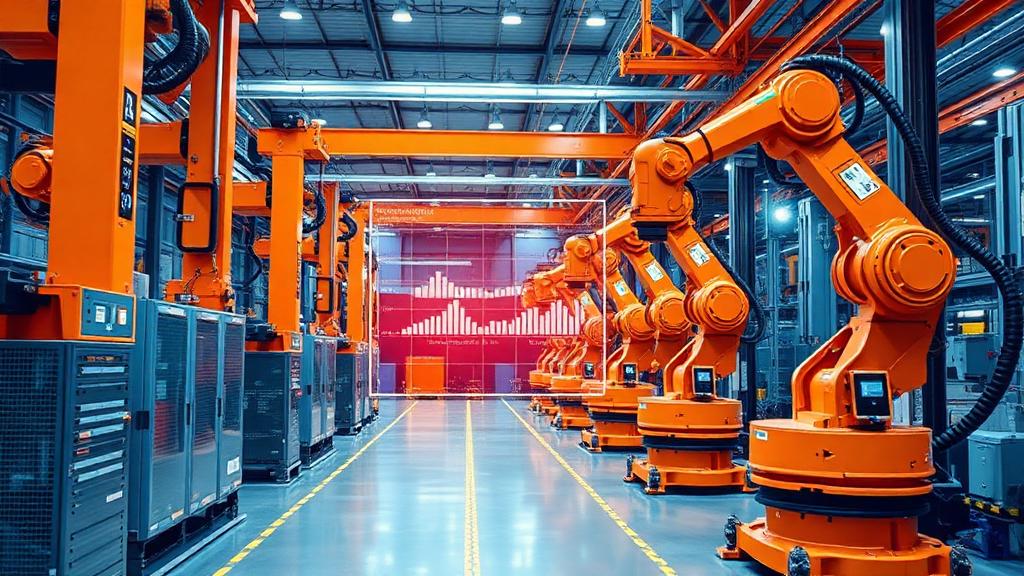
Solving Manufacturing Complexity with AI
Manufacturing has always been complex, but the modern manufacturing environment faces unprecedented challenges: global supply chain volatility, labor shortages, rising material costs, and customers demanding faster delivery with higher quality.
For middle-market manufacturers—typically $10-100M in revenue—these challenges are particularly acute. You're too large to operate on gut feel and spreadsheets, but too small to afford the enterprise solutions and consulting armies that Fortune 500 companies deploy.
This is precisely where AI delivers transformative value. Not the sci-fi AI of fully autonomous factories, but practical AI that brings clarity to complexity.
The most impactful AI applications for mid-market manufacturing:
- Demand forecasting: ML models that predict order patterns with 30-50% more accuracy than historical averages.
- Inventory optimization: Dynamic reorder points that balance carrying costs against stockout risk.
- Quality prediction: Pattern recognition that identifies defect risks before they reach customers.
- Maintenance scheduling: Predictive maintenance that prevents unplanned downtime.
- Production scheduling: Optimization algorithms that maximize throughput while meeting delivery commitments.
From Legacy Chaos to Industrial Efficiency
Here's the uncomfortable truth: most manufacturing operations run on a patchwork of legacy systems, tribal knowledge, and manual workarounds. The ERP was implemented 15 years ago and barely customized. Critical data lives in spreadsheets that only one person understands. Production planning happens in someone's head.
This "legacy chaos" isn't just inefficient—it's invisible. When everything runs on institutional memory and manual processes, you can't measure what you can't see. And you can't improve what you can't measure.
Want to see how your operations stack up?
Start Free Trial & Operations IQThe path from chaos to efficiency follows a predictable pattern:
- Visibility: Before AI can optimize anything, you need clean, connected data. This often means integrating disparate systems, digitizing paper processes, and establishing single sources of truth for critical metrics.
- Baseline: With connected data, you can finally measure performance accurately. What's your true on-time delivery rate? Real cost per unit? Actual equipment utilization? These baselines reveal where the biggest opportunities hide.
- Automation: Start with high-volume, rule-based decisions. Automatic reorder triggers. Dynamic scheduling adjustments. Automated quality checks. Each automation frees human capacity for higher-value work.
- Intelligence: With clean data and automated processes, AI/ML models can deliver genuine insight. Predictive capabilities that no human could replicate. Pattern recognition across thousands of variables.
This progression isn't optional—it's sequential. Companies that try to jump straight to "AI implementation" without addressing data quality and process foundations waste time and money.
Measuring the Impact of Fractional Expertise
Implementing these changes requires expertise that most mid-market manufacturers don't have in-house. You need someone who understands both the technology and the operational realities of manufacturing—a rare combination.
This is where fractional expertise becomes transformative. A fractional COO with manufacturing experience can:
- Audit current operations and identify the highest-impact improvement opportunities
- Design a realistic technology roadmap that accounts for legacy system constraints
- Lead implementation without disrupting production
- Build internal capabilities so improvements stick after the engagement ends
- Measure and report ROI to ensure accountability
The economics are compelling. A 6-month fractional engagement might cost $75-150K. But if that engagement delivers a 20% reduction in inventory carrying costs for a $30M manufacturer, the ROI is 5-10x within the first year.
For industrial services companies—field service, maintenance, equipment rental—similar principles apply. AI-driven scheduling optimization, predictive maintenance, and resource allocation can deliver double-digit efficiency improvements when implemented correctly.
The key is matching the right expertise to your specific situation. A manufacturing AI initiative led by someone without shop floor experience will struggle. An operations transformation led by someone who doesn't understand modern technology will miss opportunities.
AI-matching ensures you get both: manufacturing expertise and technology capability, precisely matched to your challenges.